This is the multi-page printable view of this section. Click here to print.

Return to the regular view of this page.

Channels

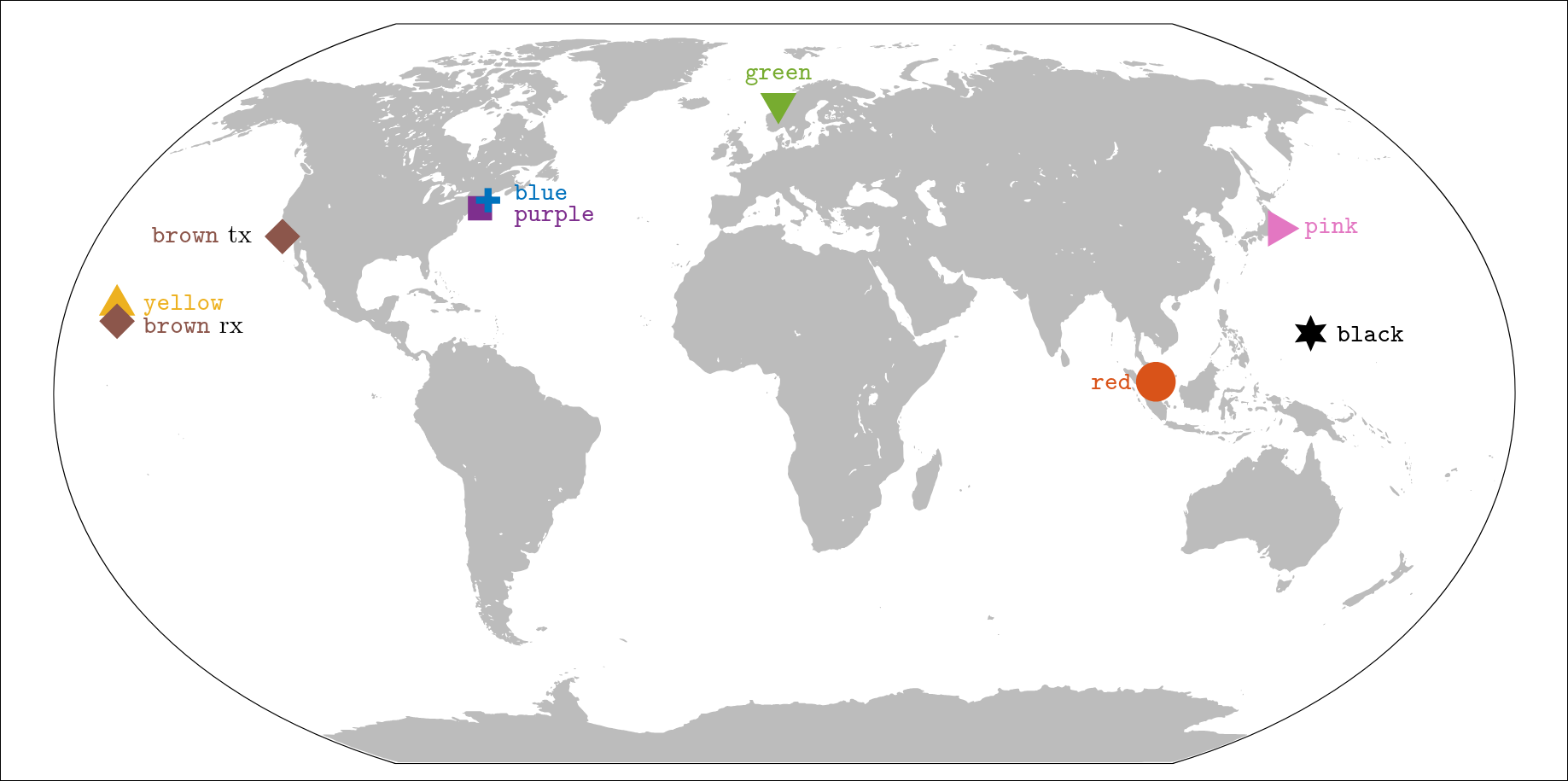
Eight color-labeled underwater acoustic channels recorded across sites worldwide, spanning shallow and deep water, short and long range, and fixed and mobile platforms.

The channels contained in this library come from various experiments. The experiments differ by geographical location, transmission distance, water depth, transmitter/receiver mobility, acoustic bandwidth, and the size of the recording array. The channels are color-labeled, and a detailed description of relevant parameters is given below for each. The channels are available for download from Zenodo:

DOI (https://doi.org/10.5281/zenodo.21287414)

Each channel is estimated from the experimental data and stored as a tensor of complex-baseband impulse responses evolving over time, with dimensions [delay, receiver, time]. If a recording array is available, the tensor holds one matrix for each array element. Each column of this matrix is an instantaneous channel response as a function of delay, that is, the channel vector h^[n]\hat{\underline{\mathbf{h}}}[n] at time index nn. Successive columns correspond to different, equi-spaced instants in time. Any motion-induced delay drift is suppressed in the channel matrix, leaving the drift-free response h^(τ,t)\hat{\underline{h}}(\tau, t), which compresses efficiently for storage. A separate vector, the phase estimate φ^(nTs)\hat{\varphi}(nT_s) stored as phi_hat, is provided that contains the uncompressed time-varying channel phase, which is directly related to the delay drift. Here TsT_s is the sampling interval along the delay axis. To fully reconstruct the channel, the stored matrix needs to be decompressed, and the phase/delay needs to be imparted to re-introduce the phase shift and the delay drift. Details of this process, along with the ready-to-use code, are given in the User’s Guide. The stored variable names, and the alternative convention in which only the phase θ^(nTs)\hat{\theta}(nT_s) is tracked (theta_hat) and the delay drift is left in the taps, are documented in the channel file format specifications.

CodenameLocationDatedT/dR/dw [m]Mobilityd [km]fc [kHz]R [ksym/s]ArrayMℓ [m]
BlueNorth AtlanticJun. 201030-60/50/100Mobile3-713104/2048Vertical120.12
RedSingaporeNov. 20246/4.6/8-20Drifting0.1-0.4259.6Vertical30.8
YellowHawaiiJul. 201150/50/100Moored3136.25Vertical240.05
7240.2
50/8.6-65/1003163.75
7163.75
PurpleNorth AtlanticOct. 200811/10/15Moored0.0612.5104/1536Cross320.0375
0.2Vertical240.05
1Vertical120.12
GreenNorwayNov. 202420/43/60Moored0.2764.5Time6410 min
BlackMariana TrenchOct. 20248718/6/8720Moored8.721812.5Planar8≥ 0.088
PinkJapanJul. 2022176/146/xMoored1464Vertical240.9-1.8
BrownPacificNov. 1994652/900-1600/4000, 5300Mobile32500.0750.0375Vertical2035

Column key: dT, dR, and dw are the transmitter depth, the receiver depth, and the water depth; d is the transmitter-receiver distance; fc is the center frequency; R is the symbol rate of the transmitted probe signal; M is the number of array elements; ℓ is the inter-element spacing. Where two values are listed for dw, they are the water depths at the transmitter and at the receiver. An "x" marks a value that was not recorded.

For the Green channel, M denotes the number of time-diversity channels formed from repeated transmissions on a single hydrophone, and ℓ denotes the inter-transmission interval.
1 - Blue

A 13 kHz mobile channel from the North Atlantic (MACE'10), recorded over a 3-7 km range with a moving transmitter and a 12-element vertical array.
  • Experiment:
    • Location: 40.2N, 70.5W
    • Date recorded: June 2010
    • Center frequency: fc = 13 kHz
    • Bandwidth: B = 5 kHz
    • Symbol rate: R = 107/2048 sym/s (approximately 4.9 ksym/s)
    • Distance: d = 3-7 km
    • Tx/Rx/water depth: dT/dR/dw = 30-60 m/50 m/100 m
    • Mobility: mobile (relative speed up to 1.5 m/s)
    • Receiving array: vertical, M = 12 elements, ℓ = 12 cm spacing (numbered top to bottom)
  • Parameters:
    • Sampling rate in delay: fs = 2R
    • Total delay coverage: up to 30 ms
    • Sampling rate in time: R/100 for the channel response, 2R for the phase/delay
    • Total time coverage: 1 minute

2 - Red

A 25 kHz drifting-boat channel recorded near Singapore in November 2024, over a 100-400 m range with a 3-element vertical array and impulsive ambient noise.
  • Experiment:
    • Location: Singapore
    • Date recorded: November 2024
    • Center frequency: fc = 25 kHz
    • Bandwidth: B = 9.6 kHz
    • Symbol rate: R = 9.6 ksym/s
    • Distance: d = 100-400 m
    • Tx/Rx/water depth: dT/dR/dw = 6 m/4.6 m/8-20 m
    • Mobility: drifting
    • Receiving array: vertical, M = 3 elements, ℓ = 0.8 m spacing (numbered top to bottom)
  • Parameters:
    • Sampling rate in delay: fs = 2R
    • Total delay coverage: up to 40 ms
    • Sampling rate in time: R/100 for the channel response, 2R for the phase/delay
    • Total time coverage: 50 seconds

3 - Yellow

A 13 kHz channel from the KAM'11 experiment off Kauai, Hawaii, recorded over 3 and 7 km ranges using four vertical receiving arrays.
  • Experiment:
    • Location: 22.1N, 159.8W
    • Date recorded: July 2011
    • Center frequency: fc = 13 kHz
    • Bandwidth: B = 6.25 kHz
    • Symbol rate: R = 6.25 ksym/s
    • Distance: d = 3 km and 7 km
    • Tx/Rx/water depth for array 1: dT/dR/dw = 50 m/50 m/100 m
    • Tx/Rx/water depth for array 2: dT/dR/dw = 50 m/8.6-65 m/100 m
    • Mobility: moored
    • Receiving array 1: vertical, M = 24 elements, ℓ = 5 cm and 20 cm spacing (numbered bottom to top)
    • Receiving array 2: vertical, M = 16 elements, ℓ = 3.75 m spacing
  • Parameters:
    • Sampling rate in delay: fs = 2R
    • Total delay coverage: up to 35 ms
    • Sampling rate in time: R/100 for the channel response, 2R for the phase/delay
    • Total time coverage: 53 seconds

4 - Purple

A 12.5 kHz shallow-water channel from the SPACE'08 experiment off Martha’s Vineyard, with cross and vertical receiving arrays at ranges from 60 m to 1 km.
  • Experiment:
    • Location: 41.2N, 70.3W
    • Date recorded: October 2008
    • Center frequency: fc = 12.5 kHz
    • Bandwidth: B = 6.6 kHz
    • Symbol rate: R = 107/1536 sym/s (approximately 6.5 ksym/s)
    • Distance: d = 60 m (array 1), 200 m (array 2), and 1 km (array 3)
    • Tx/Rx/water depth: dT/dR/dw = 11 m/10 m/15 m
    • Mobility: moored
    • Receiving array 1: cross, 16 elements in each leg (M = 32 in total), ℓ = 3.75 cm spacing (numbered top to bottom, then left to right)
    • Receiving array 2: vertical, M = 24 elements, ℓ = 5 cm spacing (numbered top to bottom)
    • Receiving array 3: vertical, M = 12 elements, ℓ = 12 cm spacing (numbered top to bottom)
  • Parameters:
    • Sampling rate in delay: fs = 2R
    • Total delay coverage: up to 27 ms
    • Sampling rate in time: R/100 for the channel response, 2R for the phase/delay
    • Total time coverage: 55 seconds

5 - Green

A 6 kHz single-hydrophone channel from a Norwegian fjord (Norway'24), providing time-diversity data from repeated transmissions over a 270 m range.
  • Experiment:
    • Location: 60N, 5.3E
    • Date recorded: November 2024
    • Center frequency: fc = 6 kHz
    • Bandwidth: B = 4.5 kHz
    • Symbol rate: R = 4.5 ksym/s
    • Distance: d = 270 m
    • Tx/Rx/water depth: dT/dR/dw = 20 m/43 m/60 m
    • Mobility: moored
    • Receiving array: none (single hydrophone)
    • Time diversity: M = 64 channels formed from transmissions repeated every 10 minutes
  • Parameters:
    • Sampling rate in delay: fs = 2R
    • Total delay coverage: up to 400 ms
    • Sampling rate in time: R/1000 for the channel response, 2R for the phase/delay
    • Total time coverage: approximately 55 seconds

6 - Black

A vertical, 18 kHz channel recorded over the Mariana Trench in October 2024, linking a near-surface planar array to a transmitter 8718 m below.
  • Experiment:
    • Location: Mariana Trench
    • Date recorded: October 2024
    • Center frequency: fc = 18 kHz
    • Bandwidth: B = 12.5 kHz
    • Symbol rate: R = 12.5 ksym/s
    • Distance: d = 8.7 km (vertical)
    • Tx/Rx/water depth: dT/dR/dw = 8718 m/6 m/8720 m
    • Mobility: moored
    • Receiving array: planar, M = 8 elements arranged at the vertices of two concentric squares (outer square side 264 mm, inner square side 88 mm, so that ℓ ≥ 88 mm)
  • Parameters:
    • Sampling rate in delay: fs = 2R
    • Total delay coverage: up to 7 ms
    • Sampling rate in time: R/100 for the channel response, 2R for the phase/delay
    • Total time coverage: 36 seconds

7 - Pink

A 6 kHz, 14 km channel recorded off Kochi Prefecture, Japan in 2022, covering flat, up-slope, and down-slope bathymetry with a 24-element vertical array.
  • Experiment:
    • Location: Off the coast of Kochi Prefecture
    • Date recorded: July 2022
    • Center frequency: fc = 6 kHz
    • Bandwidth: B = 4 kHz
    • Symbol rate: R = 4 ksym/s
    • Distance: d = 14 km
    • Tx/Rx depth: dT/dR = 176 m/146 m
    • Water depth dw: varying; the data cover down-slope, up-slope, and flat bathymetry, with a water depth of 200 m in the flat case
    • Mobility: moored
    • Receiving array: vertical, M = 24 elements at most, in six hydrophone groups. Within each group, the inter-element spacing is ℓ = 0.9 m; the distance between groups is 1.8 m.
  • Parameters:
    • Sampling rate in delay: fs = 2R
    • Total delay coverage: up to 210 ms
    • Sampling rate in time: R/100 for the channel response, 2R for the phase/delay
    • Total time coverage: 55 seconds

8 - Brown

A 75 Hz trans-Pacific channel from the 1994 ATOC project, spanning 3250 km between a deep-water source off San Diego and a 20-element vertical receiving array east of Hawaii.
  • Experiment:
    • Location: eastern North Pacific, from off San Diego, California, to east of Hawaii
    • Date recorded: November 1994
    • Center frequency: fc = 75 Hz
    • Bandwidth: B = 37.5 Hz
    • Symbol rate: R = 37.5 sym/s
    • Distance: d = 3250 km
    • Tx/Rx depth: dT/dR = 652 m/900-1600 m
    • Water depth dw: approximately 4000 m at the source and 5300 m at the receiver
    • Mobility: mobile
    • Receiving array: autonomous vertical line array, M = 20 elements, ℓ = 35 m spacing, spanning 900-1600 m depth
  • Parameters:
    • Sampling rate in delay: fs = 2R
    • Total delay coverage: up to 7 seconds
    • Sampling rate in time: R/10 for the channel response, 2R for the phase/delay
    • Total time coverage: 13 minutes